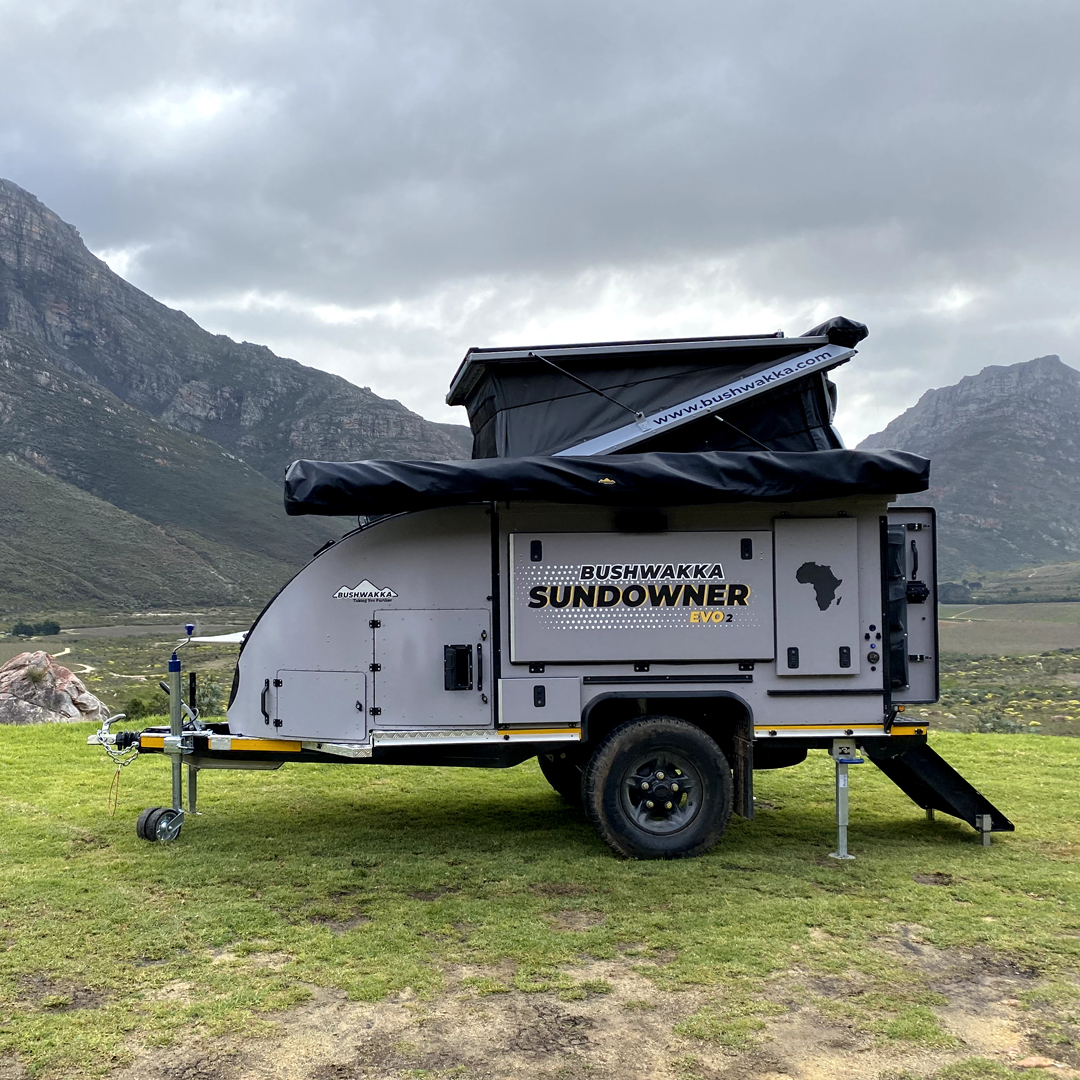
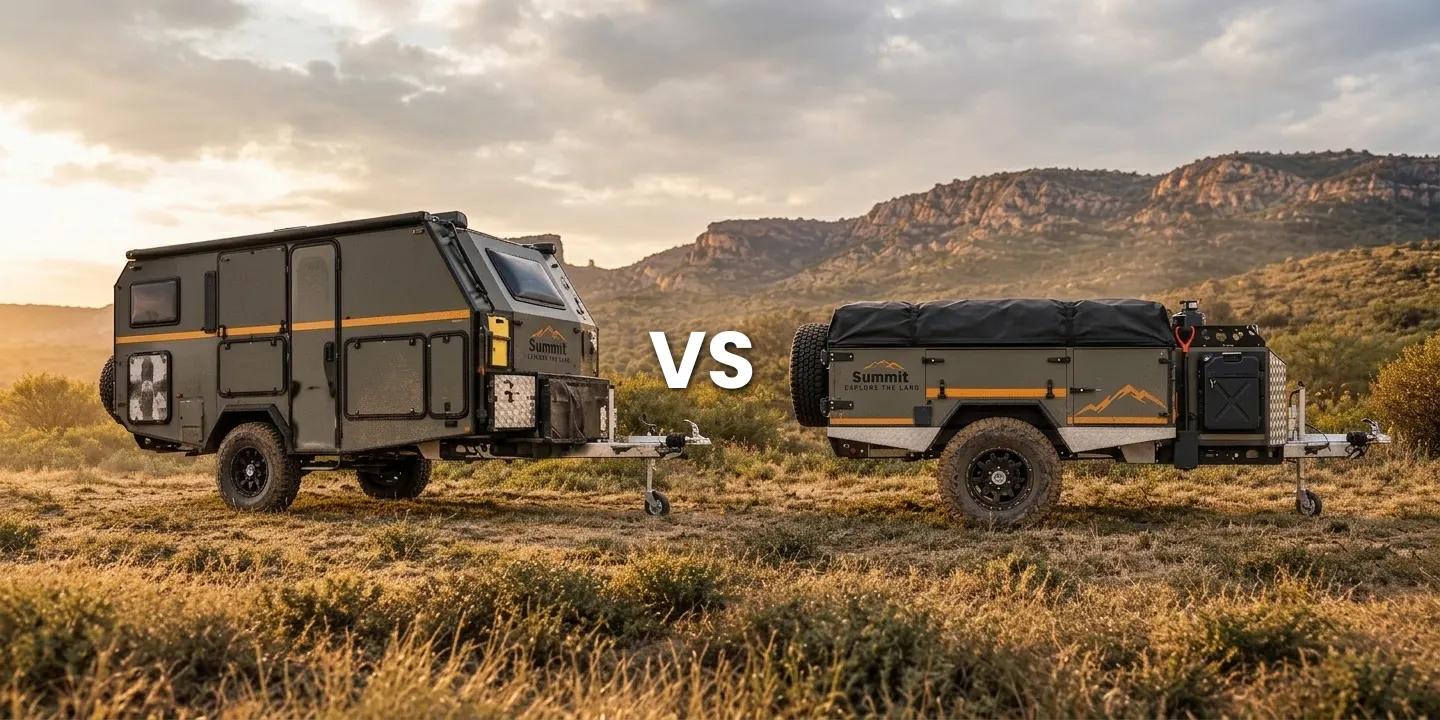
You've decided you want to get off the tar and camp properly. The only question left is what to tow behind you. An off-road trailer and an off-road caravan can both handle a rutted 4x4 track, but they solve very different problems once you actually get to camp. The right choice comes down to how many people are travelling, how long you're staying, and how much living space you actually want to set up and pack away each day.
Quick answer: Choose an off-road trailer if you're a couple or solo traveller who wants fast setup, a lower cost, and don't mind cooking outdoors. Choose an off-road caravan if you're travelling as a family, staying longer than a weekend, or want a proper bed, bathroom facilities and shelter from the weather without building or breaking down a campsite. Both categories are available to rent or buy on 4x4 Things: browse off-road trailers or browse off-road caravans.
What's the Real Difference Between a Trailer and a Caravan?
| Feature | Off-Road Trailer | Off-Road Caravan |
|---|---|---|
| Living space | Compact, mostly outdoor living | Full enclosed living space |
| Typical GVM | Often under 750kg | Often 750kg+ |
| Licence needed | Code B (check GVM) | Often Code EB (check GVM) |
| Setup time | Minutes | Longer, but done once per stop |
| Ground clearance / stability | High clearance, lower centre of gravity | High clearance, taller profile |
| Water capacity | Basic onboard storage | Often 100L+ with onboard geyser |
| Best for | Couples, solo travellers, short stops | Families, longer stays, more comfort |
An off-road trailer is, at its simplest, a rugged storage box on wheels. Most of the living happens outside it, around a fold-out kitchen or an awning. An off-road caravan is a hard-sided, self-contained unit where the kitchen, bed and often a wash-up area are all built into the shell. Both are designed to survive a challenging dirt road and even Oom Jannie's rocky farm track; the difference is in what happens once you've stopped for the night.
Size and Living Space
Trailers are compact by design. A unit like the Easy Camp Trailer sleeps 3 but keeps everything packed into a light, low-profile box with a simple kitchenette. You're camping with a tent or the trailer's own fold-out sleeping area, not living inside the unit itself. Caravans go the other way: the Jaguar Zazu 2, for example, is a fully enclosed off-road caravan with a double bed, wash-up area, geyser and 100 litres of onboard water storage, all inside a hard shell you can stand up and move around in. If you want a proper night's sleep off a real mattress and shelter that isn't canvas, we think a caravan wins every time. If you're travelling light and don't need indoor living space, a trailer is usually all you need.
Weight, GVM and Licence Requirements
This is where most first-time buyers and renters get caught out. Whether you can legally tow a given trailer or caravan on an ordinary Code B licence comes down to one number: its Gross Vehicle Mass (GVM). Units under 750kg GVM generally fall under a standard Code B licence; heavier units typically require a Code EB licence. This applies equally to trailers and caravans: the unit's category doesn't exempt it from the rule, only its actual GVM does. We've covered this in full, including how to check a specific unit's GVM before you commit, in our complete guide to Code EB licences for towing a caravan in South Africa before you book or buy either category if you're not certain what licence you hold.
Off-Road Capability: Ground Clearance, Suspension and Rollover Risk
Both categories are built for the same job: high ground clearance, off-road-rated tyres, reinforced chassis and enough approach and departure angle to handle a rutted track without getting yourself in a pickle. Where they diverge is stability. Because a trailer's payload sits low and close to the axle, most off-road trailers, particularly compact or pop-up designs, carry a lower centre of gravity than a caravan of similar size, which really helps reduce rollover risk when you're navigating uneven or off-camber terrain. A taller, hard-sided caravan carries more of its weight higher up (just like a lot of ouks you know) so while it's just as capable of getting there, it demands more caution on genuinely technical, off-camber sections. Neither unit is risk-free off-road. This is a difference to keep in the back of your mind, not a reason to avoid caravans altogether. Good driving technique and wise choices is what is usually comes down to.
Setup Time and Convenience
If you're only stopping for one night, setup time matters more than most renters expect. A trailer typically unpacks in minutes: fold out the kitchen, pitch a tent or pop the sleeping area, and you're ready to sit back and have a well earned Brandewyn. We find that renters consistently mention this as the deciding factor for short trips, since less time setting up camp means more time actually enjoying it. A caravan, however, takes longer to level and set up properly, but keep in mind that you usually only do that once per stop, and once it's up, you have a fixed base for the rest of your stay, which pays off on longer trips where you're not moving every day.
What's Usually Included: Kitchen, Water, Power
Both categories can come well equipped, but the difference is noticeable. Trailers typically include a fold-out kitchenette, a fridge, gas cooking and basic 12V lighting, enough to self-cater without needing a caravan's built-in systems. Caravans go a step further: the Jaguar Zazu 2 example above includes a solar panel with a 100Ah battery system, a 1200W inverter, an onboard geyser and a 100-litre water tank, effectively a small, self-contained home. If you want to run a fridge and lights off-grid for several days without topping up water or power, a caravan's built-in systems make that far easier than a trailer's more basic setup.
Cost: Buying vs Renting Each Option
Trailers are almost always the cheaper entry point, both to buy and to rent. To put it in perspective: The Easy Camp Trailer above rents from R500/day, versus R980/day for a Jaguar Zazu 2 caravan. If you're not sure yet whether off-road camping is something you'll do often, we'd say renting either one is the best way to find out before you commit to buying anything. We've compared the two approaches directly in our guide to renting vs buying a camper in South Africa, which is worth a read if you're considering either buying or renting and you're wondering about cost. If you do decide to buy, our off-road caravan buying guide covers what to check before you commit.
Which One Should You Choose?
Choose a trailer if you're a couple or solo traveller, moving spots frequently, don't want to spend 30 minutes setting up and packing down at every stop, and you're comfortable cooking and living mostly outdoors. Choose a caravan if you're travelling as a family or with the lighties, you want proper shelter from rain and wind, you're staying multiple nights in one spot, or you simply want to arrive somewhere and have an actual bed and bathroom facilities waiting for you. Neither option is objectively better. They're each good for different trips and different scenarios. If you have any more questions, please feel free to reach out to our team and we'd love to help you decide.